


I traveled to Shanghai last week for our first ever Stripe Tour in China (more on Tour itself on LinkedIn soon!). It was my first visit to China since the pandemic, and it was surreal to witness the Shanghai that has emerged through multiple breaking changes: zero-covid policies, the ubiquity of the super apps, the housing collapse, electric vehicles, and now AI. The culture felt surprisingly familiar in many ways (people were direct, talkative, and showed care via excess), just in a completely different environment that everyone had quickly settled into.
The week before my trip, Muse (Meta’s personal AI agent) launched. I spent my minutes between meetings testing its limits – paying Oakland city taxes, challenging it to find the perfect cat and/or baby toy (trick question – it’s a cardboard box or a sheet of paper), and researching socks for my trip (does no one else get sock-related packing anxiety?). In true 2026 AI fashion, I felt the AGI in the happiest paths (and raved to all my friends) and felt the slop in the saddest paths (and ranted to all my friends).
I was excited for Muse to help me navigate China, but it consistently got stuck. The agent buddies I’d come to rely on could not penetrate a closed ecosystem of super apps. In one instance, I’d asked Muse to get me special exhibition tickets for a new exhibit at the Museum of Art Pudong (la Galerie du 19M), but it got stuck when WeChat was required to continue.
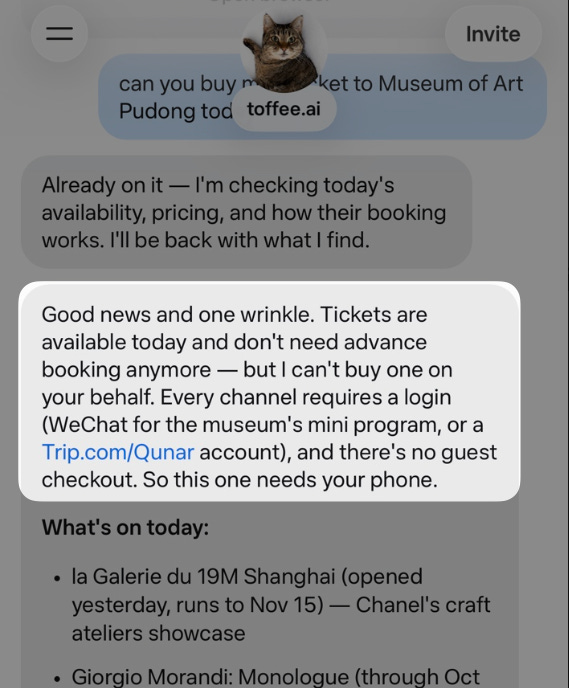
China leap-frogged past the era of websites straight into authenticated mobile experiences. The mobile implications are relatively well-known to folks at this point (though still consistently surprising to witness – wdym our beautiful Stripe websites aren’t valued or even looked at in China? 😢). But with AI, I felt the downstream impact of everything requiring authentication. Authentication meant there was no way for ChatGPT to search-tool its way to the top dishes for me on Dianping, and no way for Muse’s computer use capabilities to book a reservation on WeChat.
Traveling in Shanghai in 2026 is a tale of forced adaptation. I had to download Alipay to pay and to get the best deals. Shops would not accept my crisp 2019 paper RMB. I had to use Didi. Taxis would not stop for my flailing arm. I had to download and learn how to use WeChat’s partially localized interface not just to chat, but also to sign up for the 19M tickets.
However, once I downloaded every super app and learned a few new Chinese terms, the experience was so seamless that I forgot all about my AI friends. Every restaurant had its most popular dishes listed. Local recommendations via collective intelligence felt smarter and faster to access than recommendations via artificial intelligence. Humans at hotels and restaurants responded ~instantly to my translated English requests on WeChat. Cars in any shape or size (though almost exclusively EVs) came in under five minutes via whatever super app I currently had open. I could even pay a little extra to incentivize cars to take my request. The super apps had thought of everything, and I stopped finding things I wanted to delegate to AI.
Even the 19M tickets made no sense for an agent to retrieve on my behalf because there was simply no friction to reduce. I scanned a WeChat QR code to buy a ticket, scanned another code upon entry to queue for the exhibition, then they scanned my code in exchange for a physical bracelet for seamless admittance into the exhibit. Each step was obvious and fast enough that AI would not have helped.
In all of these cases there was no straying from the hyper-efficient golden path. The path was so well-paved I never needed an agent, but it only went where the super apps had already decided to go. There was no way to blaze a new trail, not even with our most capable personal agents.


These experiences stood out to me because during Tour, when I spent time with Chinese businesses, founders, and VCs, the topic of opportunities to innovate came up in multiple conversations. In each case, I eagerly demoed Muse, and spoke about the many inefficiencies AI could help us solve. Many were confused. “What inefficiencies do you mean?” I explained how AI influencers on X were booking travel and finding refund and savings opportunities in their inboxes! They remained confused because booking a train ticket, claiming savings, or getting a refund are already instant one-tap, one-QR, or one-WeChat activities within their super apps.
Others I talked to felt validated in their ambition to sell beyond China. AI companies were building to sell globally from day one, and many were eyeing the US specifically. One VC I spent a while with on this topic followed up with a Chinese article that explains why Americans are obsessed with Muse: “The reason is simple: the friction of living in the United States is too high.” (“原因很简单,美国生活的摩擦成本太高了。”)
It’ll be interesting to see how adaptation to AI will play out in China. In some ways, it feels much more incremental than what we’re experiencing in the US. It’s yet another new technology that will be layered into the super apps, in an environment where friction has already been heavily sanded down.
On the other hand, fragmentation of how technology is adopted in the US has forced open ecosystem strategies from many businesses (including at Stripe, where we have to interoperate with not just many generations of payment methods, but also many generations of software our users rely on). This benefits AI agents, which can then make experiences feel integrated even while the underlying systems and processes remain fragmented.
I suspect the rise of personal AI agents isn’t just a product of better models. It’s also a product of friction. I wonder if on the other side of the personal AI agent race to remove all our frictions, the average consumer experience will start to feel more like China’s, at least on the surface. Underneath, though, instead of a few super apps competing amongst each other to optimize where the path goes, it’ll be our own agents, cutting through the thickets of fragmentation and blazing new paths.
This was an interesting read! I am curious if access and affluence in a society has a relation to AI usage. How would economies like India react where pockets of society are extremely tech savvy, and then there is huge wealth disparity. The angle of super apps was very interesting.